
June 25, 2026
If you have ever driven through Lake Bluff and thought, why does this village feel so visually rich, the answer is in the homes. Rather than following one dominant look, Lake Bluff brings together cottages from its resort-era beginnings, formal revival houses, postwar neighborhoods, and striking newer custom builds. If you are buying, selling, or simply trying to understand what gives this market its appeal, knowing the architectural layers can help you see Lake Bluff more clearly. Let’s dive in.
Lake Bluff did not develop all at once, and that is a big part of its charm. According to village history, the community began in the 1870s as a camp-meeting resort, with about 200 acres laid out in small lots and early Gothic Revival or vernacular gable-front houses. Lake Bluff later incorporated as a village in 1895.
Over time, that early cottage fabric was joined by year-round homes, larger estate properties along the Green Bay Road corridor and lakefront, postwar subdivisions west of the Metra tracks, and more recent tear-down and new-construction cycles. Today, that history creates a streetscape that feels layered rather than uniform.
For you as a homeowner or buyer, that means Lake Bluff offers more than one version of home style. You may find an intimate cottage on a smaller lot, a formal brick Colonial Revival, a postwar house with practical layout, or a custom home with modern lines. That range is one reason the village continues to stand out on the North Shore.
Many North Shore communities are known for a narrower architectural identity. Lake Bluff is different. Local historical and preservation records describe a mix that includes Cottage, Queen Anne, Victorian, Craftsman, Prairie, Four Square, Colonial Revival, Georgian Revival, French Eclectic, Tudor Revival, Italian Renaissance Revival, Mission Revival, Mediterranean Revival, Modern, and Post Modern homes.
That breadth gives Lake Bluff a more eclectic feel. Instead of reading as a single-style estate enclave, the village feels like a place where different eras remain visible at the same time. For sellers, that can be a major advantage because architecture becomes part of the property story rather than just background.
The village has also taken steps to preserve that identity. Lake Bluff maintains historic preservation regulations and has combined multiple historic-resource surveys, public records, and museum material into an interactive house-by-house map. That effort helps keep architectural context front and center.
The traditional cottage is one of Lake Bluff’s most important housing types. These homes trace back to the camp-meeting era, and village planning documents note that many remain in the eastern portion of the village.
These cottages tend to create a human-scale streetscape. Built on small lots, they often feel closely tied to the landscape and to the village’s original resort character.
Many have also been expanded or altered over time to meet current needs. For you, that can mean a home with historic character on the outside and a more adaptable layout inside. It is one of the clearest examples of how Lake Bluff blends preservation with everyday livability.
Colonial Revival is one of the most enduring styles in Lake Bluff. The village survey describes these homes as symmetrical and rectangular in plan, often with multipane double-hung windows, shutters, and paneled doors.
This style remained popular well into the 1940s and 1950s. In some cases, Colonial trim was even applied to one-story ranch houses as well as two-story homes, which shows how durable the style became over time.
If you are drawn to crisp curb appeal and a more traditional exterior, Colonial Revival homes often deliver that in a straightforward way. Their balanced facades and restrained detailing create a look that feels timeless without being overly ornate.
Georgian Revival can be thought of as a more formal branch of the Colonial tradition. In Lake Bluff, these homes often include wings, columned fronts or porticos, and classical detailing.
That architectural language creates a strong sense of structure and permanence. Brick or clapboard exteriors, symmetrical fronts, and carefully composed entries give these homes a polished appearance that tends to photograph well and present clearly to buyers.
For sellers, that matters. Homes with strong visual order often make an immediate impression, especially when their historic character has been well maintained.
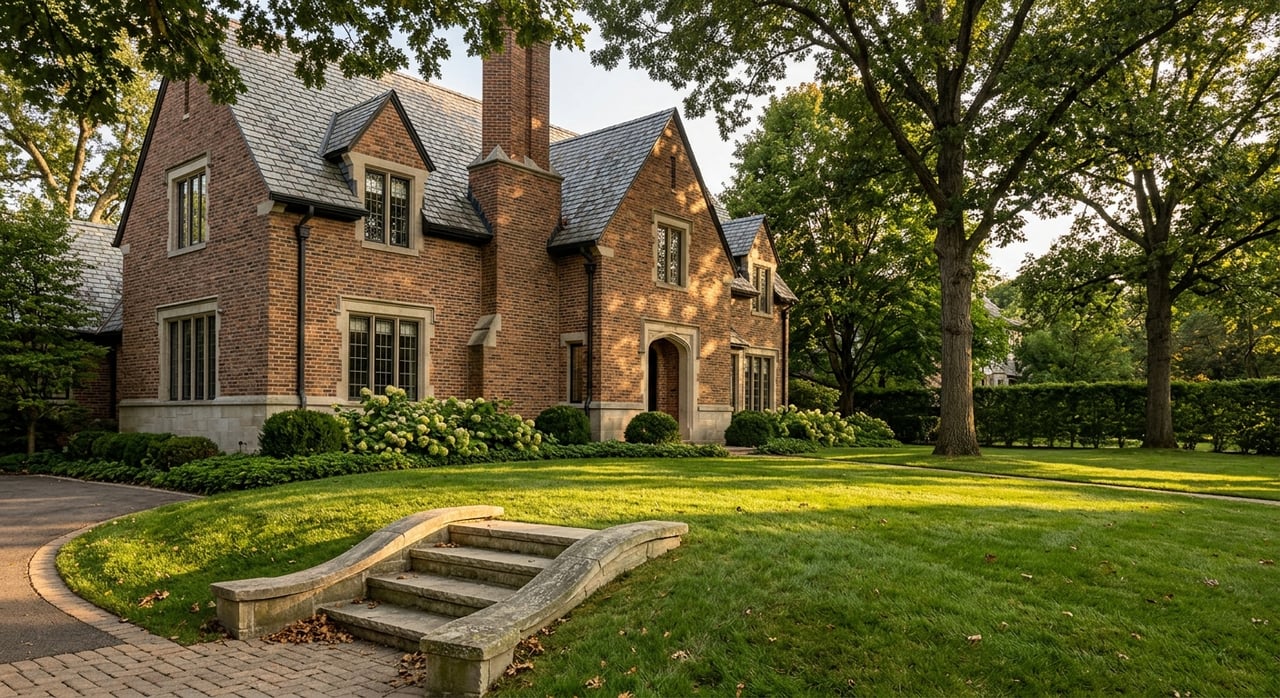
Lake Bluff’s estate houses are where the village becomes especially memorable. The historic survey notes that many early-20th-century estate homes drew inspiration from French, Tudor, Georgian, and American Colonial architecture.
The same survey also identifies major architects connected to the village, including David Adler, Howard Van Doren Shaw, Benjamin Marshall, D. H. Burnham & Co., Harrie Lindeberg, Webster Tomlinson, and Frost and Granger. That depth of architectural authorship gives Lake Bluff unusual credibility for buyers who pay close attention to design pedigree.
These homes often bring together steep roofs, stone or stucco exteriors, tile roofs, arches, courtyards, and loggias. In some cases, enough surrounding land remains to preserve the original stately setting. The result is a kind of curb appeal that feels layered, substantial, and hard to replicate in newer development.
One of the more interesting facts about Lake Bluff is that French Eclectic architecture appears here more often than in other North Shore communities, according to the village survey. That makes it a meaningful part of the local visual identity.
French Eclectic homes often stand out through their picturesque massing and refined detailing. In a village already known for variety, this style helps deepen the sense that Lake Bluff is not defined by just one estate formula.
For buyers who want something distinctive but still classically rooted, this style can be especially appealing. For sellers, recognizing that local rarity can help shape how a home is positioned and described.
Tudor Revival is common across the North Shore, but Lake Bluff’s estate inventory includes fewer significant Tudor examples than you might expect. The village survey specifically notes that contrast.
That matters because it changes the overall feel of the housing stock. Compared with nearby areas where English Manor and Tudor-inspired homes may dominate, Lake Bluff reads as more varied and less tied to a single historic look.
If you are comparing North Shore communities, this difference may help explain why Lake Bluff can feel more relaxed and more eclectic, even when the homes are substantial in scale.
Lake Bluff is not only about historic styles. The village survey highlights notable Modern and Post Modern examples, including the Edward McCormick Blair House as a fine Mid Century Modern residence and a Post Modern design by Stanley Tigerman as one of the North Shore’s more inventive examples.
More broadly, local records describe a late-20th- and early-21st-century building boom that included tear-downs, new construction, additions, and remodels. West of the Metra tracks, the housing stock is mostly post-World War II, which adds another chapter to the village’s architectural story.
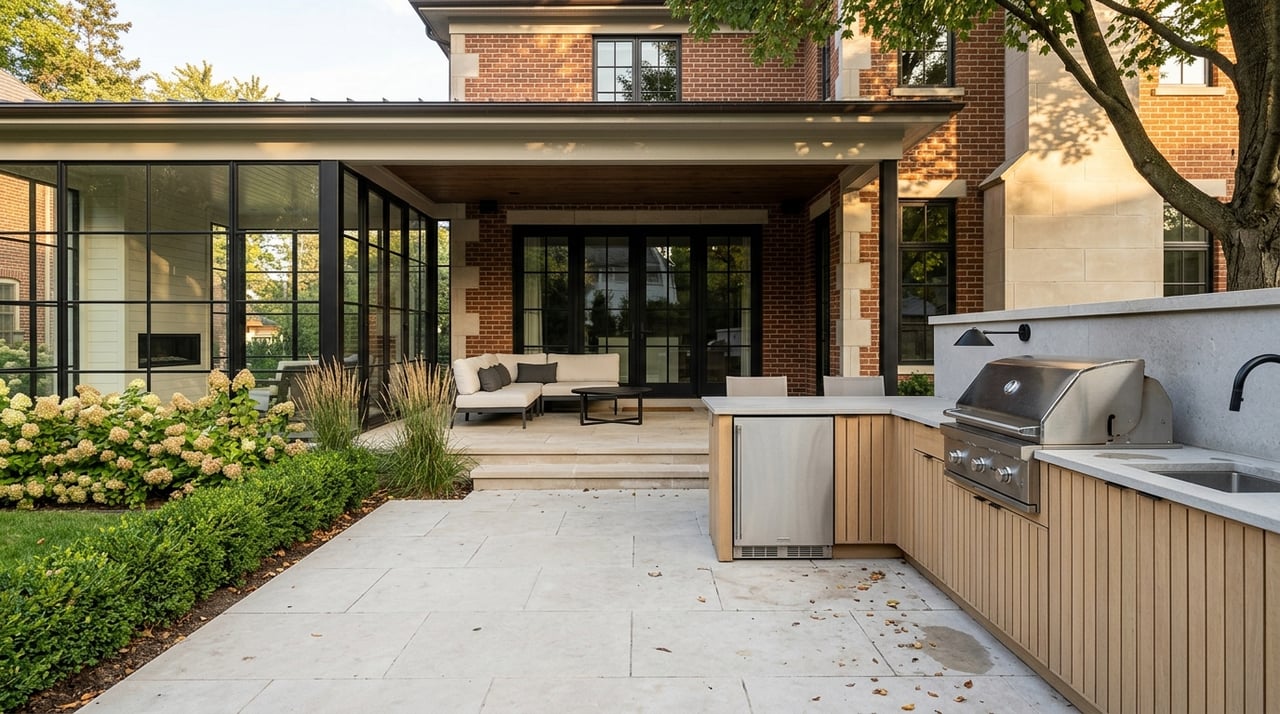
Modern and postmodern homes usually rely less on historic ornament and more on clean geometric forms, flat wall surfaces, expanses of glass, and inventive massing. In Lake Bluff, that can make newer custom homes stand out while still fitting into the village’s larger pattern of architectural diversity.
Architecture shapes more than appearance. It also influences how a home is perceived in the market, how it lives day to day, and how it connects to the surrounding streetscape.
For buyers, understanding style can help you sort through options more quickly. A cottage may offer historic charm and a close connection to the original village fabric. A Colonial or Georgian Revival home may appeal if you want order, symmetry, and a more traditional presentation. An estate revival house may offer stronger visual drama and a more layered relationship between house and grounds.
For sellers, architectural clarity matters because buyers respond to a well-defined story. In a place like Lake Bluff, that story is often tied to period details, setting, scale, and how a home fits within the village’s broader architectural mix. That is especially true for historic and design-forward properties, where presentation and pricing both benefit from local architectural context.
Lake Bluff’s preservation framework plays a meaningful role in keeping this mix visible. The village describes the real estate community as a valued preservation partner, and its comprehensive plan references incentives such as tax abatements, waived building permit fees, and floor-area-ratio allowances for landmark properties.
These tools support rehabilitation and reuse rather than automatic replacement. That helps explain why so much of Lake Bluff’s earlier housing stock continues to shape the village identity today.
If you own an older or architecturally significant home, that context can matter when you plan updates or think about future resale. Buyers are often not just purchasing square footage. They are also responding to authenticity, continuity, and setting.
What ultimately sets Lake Bluff apart is not just the presence of beautiful homes. It is the way different types of homes coexist.
Resort cottages, formal revivals, estate properties, postwar houses, and newer custom builds all remain part of the village fabric. That mix gives Lake Bluff a visual rhythm that feels organic and collected over time rather than master-planned around one style.
For anyone entering the market here, that is worth understanding. Architectural variety is not incidental in Lake Bluff. It is one of the village’s defining strengths.
If you are thinking about buying or selling a home in Lake Bluff, especially one with architectural character, working with a team that understands design history, pricing strategy, and presentation can make a meaningful difference. To start the conversation, connect with Ann Lyon, LFC Partners.
More on real estate insights.
August 20, 2026
August 13, 2026
August 13, 2026
August 6, 2026
July 23, 2026
July 16, 2026
July 9, 2026
July 2, 2026
June 25, 2026
At LFC Partners, real estate is more than a transaction—it’s a collaboration rooted in expertise and trust. With decades of combined experience in architecture, finance, and strategic negotiation, Ann, Jeff, and Kim bring a refined, data-driven approach to every client relationship. Whether you’re buying, selling, or investing along the North Shore, you can count on their deep market knowledge, analytical precision, and unwavering commitment to results.
LFC Partners Real Estate
(847) 828-9991
[email protected]
Ann Lyon
(847) 828-9991
[email protected]
Jeff Folker
(847) 504-6182
[email protected]
Kim Campbell
(312) 434-9372
[email protected]
600 N Western Ave Lake Forest IL 60045