July 2, 2026
If you picture outdoor living as a few patio chairs and a grill, Lake Forest luxury homes are changing that idea fast. In this market, outdoor space is becoming a true extension of the house, shaped by architecture, landscape, and the realities of a four-season climate. If you are thinking about buying, renovating, or preparing to sell, understanding what is trending can help you make smarter decisions. Let’s dive in.
Lake Forest is a natural fit for elevated outdoor design, but the local climate calls for more than a summer-only setup. Nearby long-term weather normals show warm summers, cold winters, annual precipitation of 37.86 inches, and annual snowfall of 38.4 inches, with average monthly highs ranging from 31.6°F in January to 84.5°F in July.
That seasonal range changes what works well on a luxury property. Buyers and homeowners often get more value from outdoor spaces that include shelter, warmth, lighting, and thoughtful hardscaping that can handle changing weather. In other words, the best spaces are designed to last beyond July and August.
One of the clearest luxury trends is the shift from a single patio to multiple outdoor “rooms.” Houzz reported that 83% of renovated outdoor spaces included a lounge area, 55% included a dining area, 53% included a quiet retreat, and 49% included dedicated gardening areas.
For a Lake Forest home, that often means creating connected zones with a clear purpose. You may see one area for entertaining, another for relaxed seating, and another for dining or planting. This layered approach tends to feel more complete and more consistent with the scale of a luxury property.
Among renovated outdoor spaces, 71% included sofas or lounge chairs and 66% included outdoor lighting. Those numbers point to a strong focus on comfort and usability, not just appearance.
In Lake Forest, lounge areas often work best when they feel tied to the home’s architecture. Covered terraces, defined seating groupings, and materials that echo the house can make the yard feel intentional instead of pieced together.
Luxury outdoor design is not only about entertaining a crowd. Houzz found that 53% of renovated outdoor spaces included a quiet retreat, which reflects a growing interest in privacy and daily use.
That can mean a tucked-away seating area, a screened porch, or a garden-facing terrace that feels separate from the main social zone. On larger Lake Forest lots, these quieter spaces can add a sense of calm without competing with the main architecture.
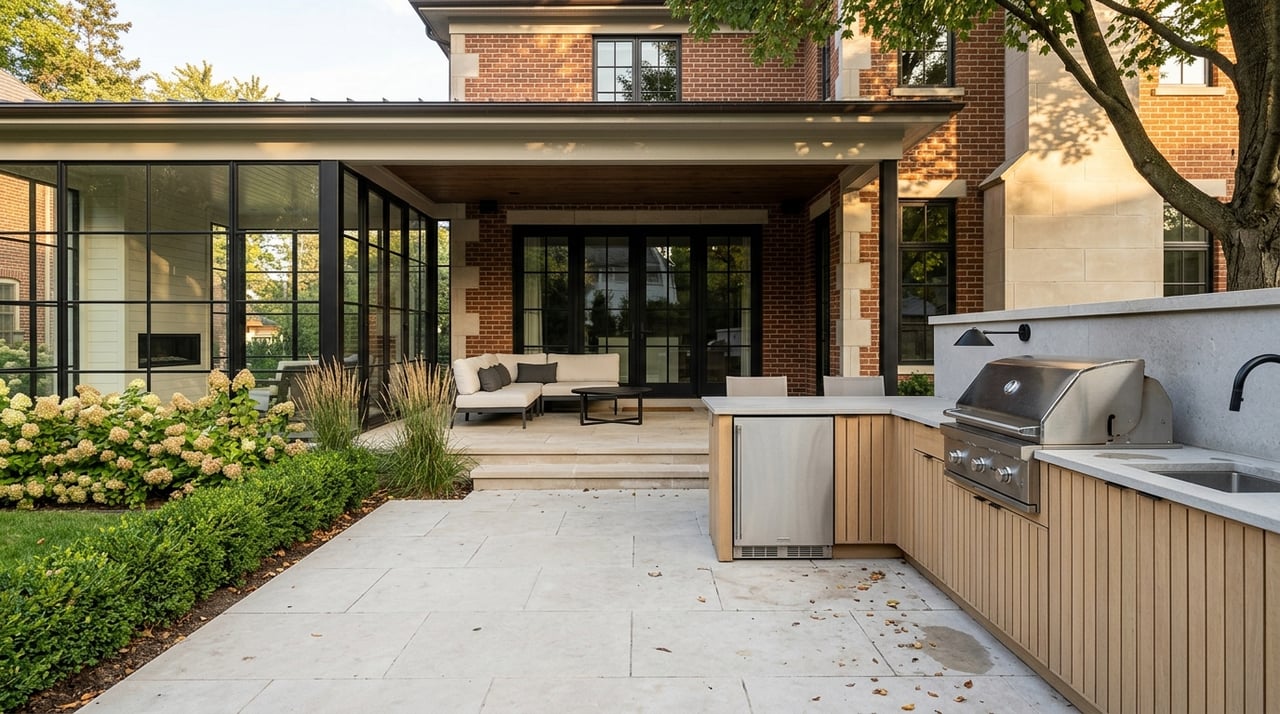
The outdoor kitchen is no longer just a grill beside the back door. Houzz found that 12% of homeowners upgrading outdoor structures were adding or improving an outdoor kitchen, and 95% of those kitchens were built from scratch.
The bigger takeaway is how complete these spaces have become. Among outdoor kitchens, 85% included a grill, 62% included a beverage refrigerator, 59% included a sink, 37% added storage, 29% included a pizza oven, and 38% included a TV.
Houzz also reported that 68% of outdoor kitchens included plumbing, electrical, or heating systems. That tells you these spaces are being designed as permanent lifestyle features, not temporary add-ons.
For Lake Forest homeowners, this fits the broader move toward true outdoor rooms. A well-planned kitchen can support entertaining while still feeling integrated with the home, especially when paired with covered dining or lounge space.
Because Lake Forest weather can shift quickly, comfort features are becoming more important. Houzz reported that shade structures accounted for 35% of outdoor structure projects, partially covered outdoor kitchens rose to 30%, and screened-in porches reached 14%.
These features make practical sense in a market with hot summer days, rain events, and cool evenings. They can help you use the space more often and make the outdoor environment feel polished rather than exposed.
In a climate with cold winters and shoulder seasons, outdoor living works best when it is planned with flexibility in mind. Covered seating, heating, lighting, and four-season rooms can help bridge the gap between indoor comfort and outdoor enjoyment.
For luxury homes, this kind of planning often feels more appropriate than relying on one feature alone, such as a pool or open patio. The goal is a space that remains appealing across much more of the year.
Planting and landscape design remain central to outdoor appeal. Houzz found that plants, shrubs, and trees were the top landscape upgrade choice at 74%, while low-maintenance plantings were selected by 73%, native plants by 55%, and drought-resistant plants by 49%.
In Lake Forest, mature trees, established lawns, and formal landscape structure already play a major role in how a property presents. That makes planting choices especially important, both for everyday enjoyment and for how the home reads from the street and across the lot.
Luxury does not always mean high upkeep. The research shows a clear preference for landscapes that look refined without requiring constant work.
That is one reason hardscaping remains strong at 57%, while irrigation reached 58% and lighting led all systems upgrades at 77%. Clean paths, well-placed lighting, and durable materials can support both beauty and function.
In Lake Forest, outdoor improvements are not treated as afterthoughts. City review materials require applicants to show patios, terraces, pools, accessory structures, tree inventories, setbacks, grading information, drainage details, and impervious surface calculations.
That means a luxury outdoor project needs to work as part of the whole site. If you are considering a terrace, pool deck, court, or major landscaping change, it is important to think about how the full plan fits the property, not just the backyard view.
Because the city asks for grading, fill, and drainage details, these practical issues should be part of the design conversation from the start. They are not just technical boxes to check later.
This is especially relevant when adding hardscape such as patios, terraces, and pool decks. A beautiful design usually performs best when drainage and surface coverage are resolved early.
For historic-district and landmark properties, exterior work may require a Certificate of Appropriateness. The city’s preservation materials emphasize compatibility with massing, scale, materials, and neighborhood character, while also noting that site-related features such as porches, walls, and garden elements matter to historic character.
Natural materials are strongly encouraged, and imitation or synthetic substitutions should be avoided where possible. For sellers and owners of architecturally significant homes, this reinforces the value of outdoor updates that feel cohesive with the original property.
Outdoor living matters as a lifestyle feature, but it also matters when it is time to sell. According to the 2023 Remodeling Impact Report for Outdoor Features, estimated cost recovery reached 100% for an outdoor kitchen, 100% for an overall landscape upgrade, 104% for landscape maintenance, 95% for a new patio, 89% for a new wood deck, 83% for irrigation system installation, and 59% for landscape lighting.
The same report noted lower estimated recovery for some features, including 56% for a fire feature and 56% for an in-ground pool. Actual recovery depends on design, material quality, location, age, condition, and homeowner preferences.
For sellers, curb appeal continues to be one of the broadest value drivers. In a 2025 outdoor features summary, 92% of REALTORS said sellers should improve curb appeal before listing, 97% said curb appeal is important in attracting a buyer, and 98% said it is important to a potential buyer.
In practical terms, that means the most effective outdoor investments are often the ones that make the whole property feel polished, complete, and easy to understand. Mature planting, clean hardscape lines, strong maintenance, and good lighting can all support that impression.
If there is one idea tying these trends together, it is integration. The outdoor spaces that stand out in Lake Forest tend to feel like a natural continuation of the home’s architecture and landscape, not a separate project dropped into the yard.
That is especially important in a luxury market where buyers pay attention to proportion, materials, and setting. Cohesive outdoor rooms, restrained but high-quality finishes, and landscape design that respects the scale of the property often create the most lasting appeal.
If you are preparing a Lake Forest home for sale or thinking about which improvements will resonate with future buyers, a well-planned outdoor strategy can strengthen both daily enjoyment and market presentation. For tailored guidance on positioning a luxury property in this market, connect with Ann Lyon, LFC Partners.
More on real estate insights.
July 23, 2026
July 16, 2026
July 9, 2026
July 2, 2026
June 25, 2026
June 18, 2026
June 11, 2026
June 4, 2026
May 28, 2026
At LFC Partners, real estate is more than a transaction—it’s a collaboration rooted in expertise and trust. With decades of combined experience in architecture, finance, and strategic negotiation, Ann, Jeff, and Kim bring a refined, data-driven approach to every client relationship. Whether you’re buying, selling, or investing along the North Shore, you can count on their deep market knowledge, analytical precision, and unwavering commitment to results.
LFC Partners Real Estate
(847) 828-9991
[email protected]
Ann Lyon
(847) 828-9991
[email protected]
Jeff Folker
(847) 504-6182
[email protected]
Kim Campbell
(312) 434-9372
[email protected]
600 N Western Ave Lake Forest IL 60045